
Security, Safety & Equity in Public Facilities: Albuquerque Public School District’s Approach to Facility Security Planning
by Justin Depoy, AICP
Providing a secure and safe environment in public facilities, particularly in public schools, is increasingly a critical part of daily facility planning practice due to a nationwide increase in politically charged violence and the expectation that public facilities provide such an environment. At the same time, public facilities must provide safety and security equitably. In this context, equity does not necessarily mean providing every facility with identical security infrastructure or funding; rather, it means ensuring that each facility receives the level and type of security infrastructure appropriate to its needs, while maintaining a consistent baseline of safety and security across the district. This is necessary both to demonstrate due diligence in providing a safe and secure environment to members of the public and, in the case of public schools, to address longstanding racial inequities in public education and comply with the New Mexico constitutional mandate that our free public schools be uniform.
Between 2017 and 2024, the Albuquerque Public Schools District (APS) implemented a comprehensive plan to equip all of its facilities with critical security hardware. This article will look at the ongoing work public schools must undertake to secure their facilities, how APS addresses equity in public school facilities as outlined by the state Constitution and interpreted in the Zuni Lawsuit of 1999, and how it allocates funding for maintenance of these security systems to ensure their long-term continuity.
Equity in New Mexico Public Schools; the Zuni Lawsuit of 1999
In 1999, New Mexico’s 11th Judicial District Court ruled that public school capital outlay funding in New Mexico was violating the State Constitution’s guarantee that the state would establish and maintain a “uniform system of free public schools sufficient for the education of all children of school age.” In response, the Public School Capital Outlay Committee drafted facility adequacy standards between 1999 and 2001, and in 2002 adopted its first version of these standards. The standards establish a minimum acceptable level of physical condition and enrollment capacity of school buildings, provide a measuring stick to evaluate any existing public school building, and define minimum sizes of space types and minimum performance criteria for educational spaces, based on Public Education Department (PED) standards for excellence (New Mexico Legislative Education Study Committee Hearing Brief: New Mexico’s System of Funding Public School Facilities, August 22, 2019).
Because of this ruling, adhering to consistent standards for public school facilities across the state of New Mexico to ensure equity is not only ethical, but also mandated by state law. This extends to all elements of a public school facility, including its security infrastructure. Therefore, any interventions to a site’s security infrastructure must be weighed, at least in part, against the measure of their impact on equity and the uniformity of educational outcomes.
Identification of Needed Public School Security Hardware
In 2017, Albuquerque Public Schools initiated the Integrated Security Systems Project, or ISSP, and the Security Assessment and Implementation Committee, or SAIC, with the primary aim of improving overall district security by first making District security hardware interoperable and compatible; then utilizing interoperability to enable direct monitoring of the systems by the Albuquerque Public School Police Department dispatch center; and finally, maintaining this infrastructure long-term and distributing equipment equitably districtwide.
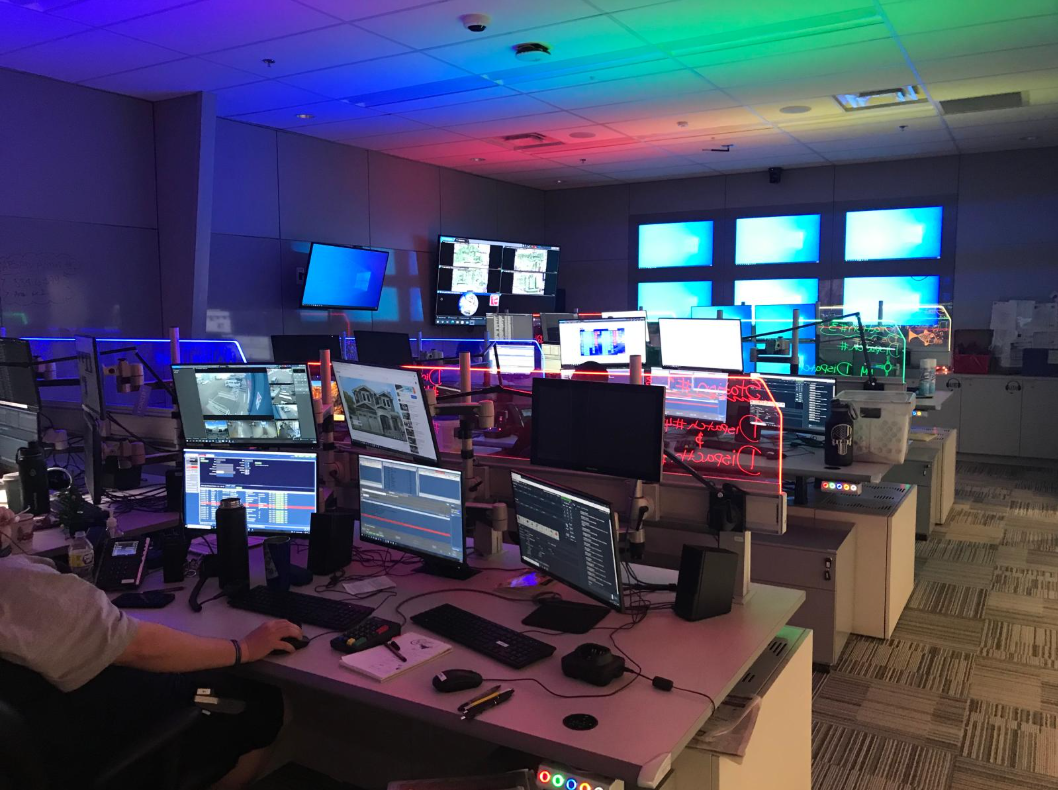
Integrated Security Systems Project (ISSP) monitoring
The project identified several key types of security hardware needed at facilities throughout the Albuquerque Public Schools system to ensure equitable security and enable effective monitoring by School Police. These included security doors that can be locked with a key from inside a classroom or office suite, so that teachers and staff could quickly lock down rooms in the event of an emergency; perimeter fencing of fields to prevent vandalism, unauthorized trespassing, and potential dangerous intruders who could cause harm to students; fire alarms that are standardized and interoperable with district IT and security infrastructure; compatible and interoperable security cameras; card access terminals at strategic locations within a school to enable secured access into the facility by staff; and a centralized security vestibule, serving as a building’s primary entry point for visitors and students, with two sets of doors controlled by the office staff and a camera doorbell that enables the staff to communicate with people entering the school through the vestibule. Because all schools would be equipped with these key security elements, the district’s security infrastructure would be equitable.
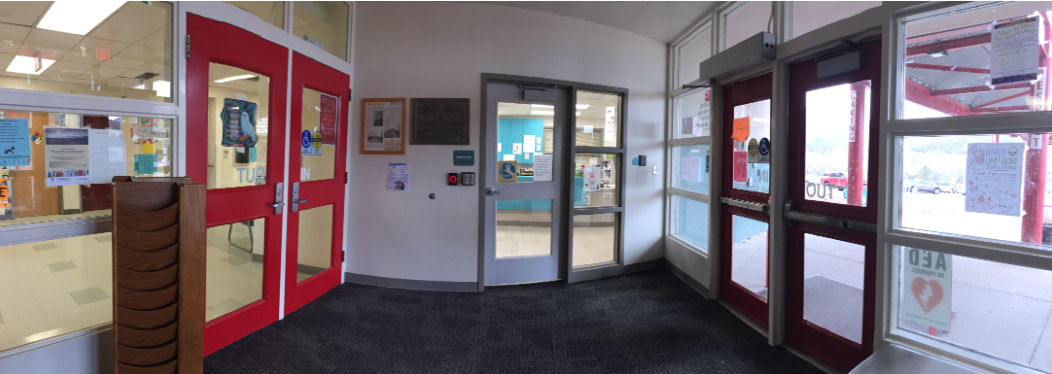
Security Vestibule
As part of these efforts, the district also undertook measures to ensure that schools would not purchase security infrastructure that was not approved. This was in part to achieve consistency in security infrastructure and to protect the district’s IT infrastructure from potential threats posed by unauthorized security hardware. As an example, under district policy, APS has not installed vape-detection equipment at schools and will not do so until an appropriate, secure, and comprehensive system is identified and funding is secured. The district’s plan also intended to eliminate ad hoc requests for equipment and instead conduct holistic assessments.
Ensuring Equitable Security Infrastructure
The vast majority of funding that public education receives comes from either local mill levies or legislative capital outlays. Local mill levies can be utilized districtwide and therefore do not, by themselves, present an equity issue. However, when funding is obtained through capital outlays from the legislature, it may raise equity concerns if that money goes to an individual school site while others do not receive a balanced proportion of appropriate security infrastructure through judicious implementation of local mill levies and other funding sources.
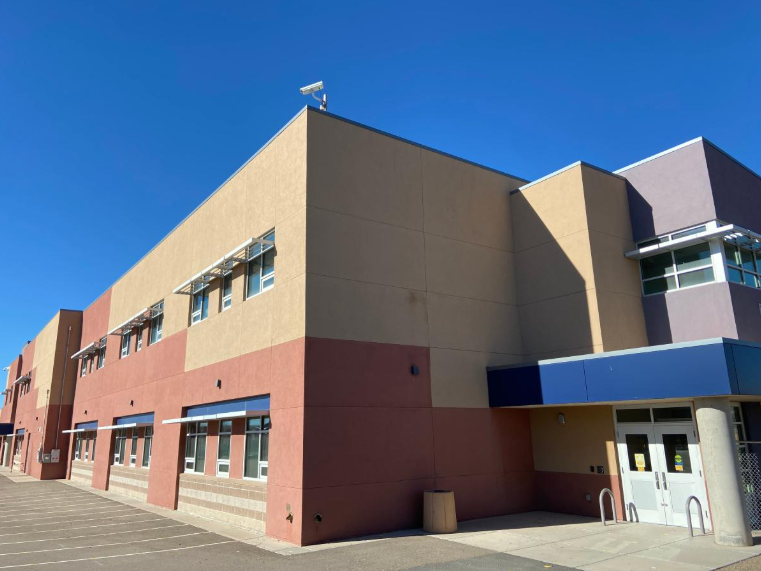
Security Cameras as part of the overall system
Albuquerque Public Schools utilizes and has utilized multiple funding sources for security projects. These sources of revenue become a tool that can be used to properly balance the often-unequal funding that schools receive from local mill levies and legislative capital outlays and ensure that all district facilities’ security infrastructure is properly funded, equitable, and fair.
In addition to concerns raised by unequal funding sources, simply providing all schools with an identical amount of capital does not necessarily mean that all school sites are equally secured. Inflation gradually increases the price of security infrastructure, larger schools often require more infrastructure than smaller ones, funding can run out before all necessary interventions are completed, and older schools generally cost more to secure due to the need to retrofit them with infrastructure like coaxial cabling and network systems.
To ensure an equitable security infrastructure, administrators conduct a holistic overview through field visits, during which stakeholders, including security experts, are invited to the site to review its overall status. These stakeholders should include a representative from the APS Police with experience in camera and alarm systems, a district architect, a district facility planner, a maintenance and operations representative, and the site administrator. When visiting the site, the site administrator is surveyed on the overall security infrastructure at their site, and then this security team walks the site with the administrator to ensure that any new security infrastructure that is requested is warranted, will support the school’s overall security, and can be properly maintained in the long term.
In addition to field visits, APS has standardized the baseline quantity of security hardware that a site will receive, based on its level (e.g., elementary or high school). An amount of a specific item, such as cameras, above the set quantity is approved by the district only if the school has been shown to require that quantity for student life, health, and safety.
Where an inequity exists and student life, health, and safety are identified as concerns, a timely response is necessary in the form of an intervention using one or more of the district’s major security systems. However, it can often take time to obtain a subcontractor quote and have vital security hardware installed, and other projects may arise in the interim. Because funding can run out in a given year before all projects are funded, requests must be triaged based on the intervention’s criticality. Projects that are deemed lower priority by the district’s security team may be postponed until further funding is received in the next fiscal year.
Conclusion
Due to limited public school facility budgets, site administrators and state legislators often lack a holistic view of a school district and an understanding that security requests can trigger an equity issue by affecting the balanced application of districtwide school funding. A school district, or public service agency, must carefully prioritize the merits of various security requests through a systematic, thorough review of school sites, ranking projects by criticality and impact on school safety and security. In doing so, public service agencies will be acting with due diligence, ensuring that all students, staff members, and residents have access to an equitable and safe facility and environment.
About the Author
Justin Depoy, AICP, is a School District Planner at Albuquerque Public Schools, Capital Master Plan (CMP) Department and has been working in that capacity since 2016. He utilizes various drafting and graphics software to produce floor plans, emergency evacuation building plans, and other facility data used by the CMP planning division and departments across the school district.